The long chain of wars sweeping across the world shows no sign of easing.
With media attention diverted from the genocide in Gaza and Ukraine relegated to the background, the spotlight first shifted to Sudan and then once again to Yemen – both mirrors of the fragmentation that, alas, continues to divide our Ummah (any reference in particular to Saudi Arabia and the United Arab Emirates is by no means accidental).
Now it is Venezuela’s turn: which country will be next in the coming weeks?
Regarding what happened in Caracas, Swordless Jihād does not mourn the arrest of Nicolás Maduro. One should not be deceived by the hypocritical and instrumental support of the Venezuelan “pharaoh” for the Palestinian cause, while it was precisely his corruption and incompetence that impoverished and starved millions of citizens.
From the standpoint of Islamic ethics, a ruler is the custodian of the well-being of the people entrusted to him (amāna), and Prophet Muḥammad ﷺ warned that every leader will be called to account for his “flock” (Sahīh al-Bukhārī 7138).
When power turns into privilege and governance into negligence, as in Maduro’s case, a Muslim’s judgment cannot but be negative.
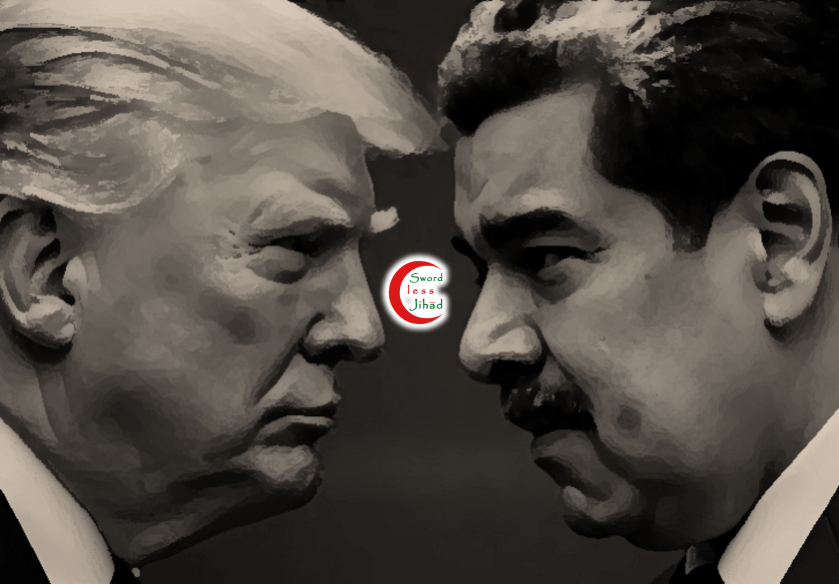
On the other hand, according to Islamic ethics, Maduro’s responsibilities as a ruler do not in any way justify or legitimize a military attack such as the one carried out by the United States under the “pharaoh” Donald Trump.
The attack and the subsequent capture of Maduro were not sudden or improvised, but rather represent the culmination of an escalation initiated by Trump through sanctions and economic pressure, aimed at forcing the Venezuelan regime to change course and distance itself from China, Russia, and Iran.
The subsequent resort to the use of force stemmed from the failure of this strategy. Maduro and the regime’s leadership were not affected directly by the economic strangulation policies pursued by the United States, to the point that they did not yield even minimally to American demands. However, at the same time, the Venezuelan people to a state of widespread and ever-worsening destitution.
Is it therefore all Maduro’s fault, as a “pharaoh” completely detached from the country’s social reality despite the populist propaganda of his regime? Certainly not.
Islām grounds its vision of human and international relations on the principle of justice (ʿadl). The Qurʾān is explicit: “O you who believe! Stand firm for Allāh as witnesses to justice, and do not let hatred of a people cause you to be unjust” (sūrat al-Māʾida, 5:8).
Any aggression – even in the form of sanctions – that strikes an entire population, depriving it of vital resources such as food, medicine, and dignity, clearly falls within the category of injustice (ẓulm), which is among the gravest of sins, especially when exercised by the strong against the weak.
The pressure and isolation promoted by Trump did not affect the so-called elites, but rather defenseless Venezuelans, despite their having no responsibility whatsoever. Islām teaches that “no soul shall bear the burden of another” (sūrat al-Anʿām, 6:164). Striking an entire population in order to force political change means violating this fundamental principle of justice.
Having inevitably failed the strategy of economic coercion, “pharaonic” arrogance (istikbār) led Trump down the path of military action and domination. We leave it to history to recount how this latest tragic chapter will unfold, but we are certain that its outcome will not be a success.
Allāh swt is not “unaware of what the wrongdoers do. He only delays them until a Day when eyes will stare in horror” (sūrat Ibrāhīm, 14:42), terrified by His judgment.
 Jihād senza Spada