
Reading time: 4m46s
African Islām occupies a central yet often underestimated place in the history of the Ummah. Therefore, recognizing the contribution of African Muslims means rediscovering an essential dimension of Islamic civilization across the centuries. A dimension from which fundamental aspects of the message conveyed to humanity by Allāh subhānahu wa taʿālā clearly emerge.
To begin with, Africa was one of the first lands to welcome Islām: the hijra to Abyssinia – an area corresponding today to Ethiopia and Eritrea – bears witness to the fundamental principle that justice and human dignity transcend geographical boundaries, national belonging, and the color of one’s skin. The Negus, who received the persecuted Muslims of Mecca, indeed continues to represent a powerful symbol of protection for believers and interreligious dialogue.
Like the Negus, classical sources agree in considering Bilāl ibn Rabāh – one of the Companions most honored by the Prophet ﷺ and chosen by him as the first muezzin (muʾadhdhin) of Islām – to have been Abyssinian as well. The story of Bilāl is still profoundly relevant today.
Born a slave in Mecca, he was freed by Abū Bakr (raḍiya Allāhu ʿanhu) because of the torture inflicted upon him by his masters for proclaiming the Tawhīd. His elevation in rank by the Messenger of Allāh was a truly revolutionary act that challenged a deeply tribal and racialized Arab context, affirming that in the sight of the Most High the worth of a person is measured by Taqwā, not by social or ethnic origin.
Over the centuries, as a matter of fact, African Muslims contributed to the life of the Ummah as scholars, jurists, mystics, explorers, and leaders of resistance against colonialism.
In West, East, and North Africa, Islām gave rise to societies deeply rooted in learning, justice, and uprightness. Empires such as Mali, Songhai, and Kanem-Bornu integrated Islām into their institutions, promoted Islamic education and sharīʿah, while maintaining constant and fruitful ties with the wider Muslim world.
An extraordinary achievement of African Islām is the establishment of great centers of learning and Islamic sciences: Timbuktu, with the University of Sankore and the mosque-universities of Djinguereber and Sidi Yahya, was for centuries one of the most important intellectual hubs of beneficial knowledge in the entire Ummah. In Timbuktu, the Qurʾān, fiqh, ʿaqīda, and tasawwuf were studied alongside mathematics, astronomy, medicine, and linguistics, as evidenced by thousands of manuscripts preserved to this day.
Timbuktu was not an isolated case, but part of a network that included cities such as Fès and Zanzibar, among others, confirming the continent’s relevance in the history of the Islamic thought.
Today, Muslims of African diasporas contribute significantly to the propagation of Islām in Europe and throughout the so-called West, where they stand at the forefront of the work of Daʿwah through mosques, associations, as well as educational and social initiatives. All these efforts offer a living testimony of a communitarian Islām that is firm in its identity and, at the same time, open and inclusive.
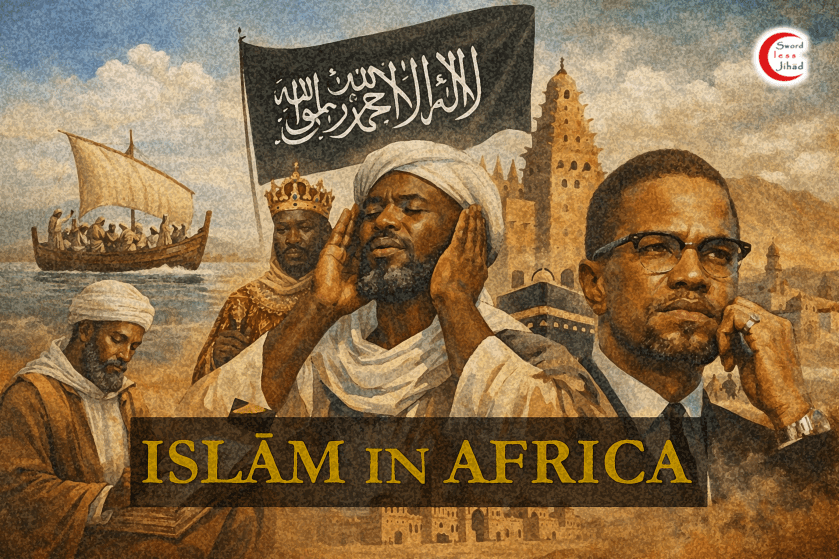
Brothers and sisters of African origin have also been deeply engaged in denouncing oppression, racism, Islamophobia, and inequality, carrying with them a historical memory of colonialism and marginalization that lends authority and weight to their voice. Figures such as Malcolm X demonstrate how Islām can be a force of liberation from dehumanization, capable of restoring dignity and guiding each individual toward moral responsibility before Allāh al-Ḥākim wa al-ʿAdl.
It must also be remembered that authentic Islām does not promote ethnic supremacism of any kind, not even in reversed forms. Hence, the struggle against injustice must not devolve into a confrontation between Black and White, nor into new hierarchies based on skin color.
Recognizing Africa’s role not as a passive periphery of the Ummah, but as a beating heart of spirituality, knowledge, ethical principles, and dissemination of the Word of the Most High, allows us to recover the universality of the Qurʾānic message and its ability to take root in diverse cultures without losing its essence.
African Muslims offer us an example of devotion to Islām, patience (ṣabr) in adversity and suffering, strength and courage in resisting evil. May they continue along the Straight Path… Allāhumma aʿinnā wa unsurnā!
 Jihād senza Spada