
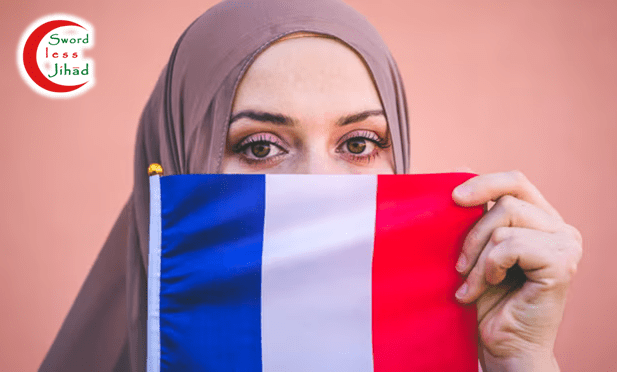
Good news for Islām and Muslims rarely comes from France. The latest in the series of bad stories tells us of the beating of a 13-year-old, Samara, occurred in the middle of Ramaḍān in front of a school in Montpellier, by two boys just a bit older than her, aged 14 and 15. The reason? “Religious” in nature, it seems, according to the declarations of Samara’s mother as reported by Le Figaro. The woman involves a third figure, another teenager (14 years old), accusing her of instigating the aggression which originated between the desks and the classrooms of the institute.
“Samara wears a little makeup,” her mother said, “and this girl is veiled,” referring to the instigator. “All day she used to call her kouffar, which in Arabic means unbeliever”, she continued, specifying that “my daughter dresses in the European style”, a way to say that she does not wear the ḥijāb. “They used to insult her the whole day, they called her kahba, which in Arabic means w*”. The situation “was no longer sustainable, neither physically nor psychologically”.
The verbal violence allegedly lasted for weeks, including spitting in addition to the insults, involving other female students as aggressors. The school principal seemed to have been aware of the situation, but he preferred not to intervene, perhaps underestimating what was happening or out of fear of raising a fuss that would have disturbed the progress of the school year. In any case, this is a serious failure and the investigations will identify the possible responsibilities of the institute’s managers.
It is a short step from verbal to physical violence, and so the beating took place. There was an ambush by the attackers, with punches and kicks that sent Samara into a coma.
Only thanks to Allāh swt the drama did not devolve into a tragedy. Alhamdulillah, Samara woke up from the coma and was able to return home from the hospital where she was hospitalized. The investigations will take their course, and will better clarify the dynamics that led to the attack. Does religion have anything to do with it? Most likely yes, as Samara’s mother claims, but not Islām, rather its fanatical and extremist caricature.
As “concerned” Muslims here at Swordlessjihād, through the article “When those who handle the ‘Hisbah’ are deviated…”, we had already sounded the alarm for the use of coercion and violence in exercising the Qur’anic duty to “order good and forbid evil” (Sūrat Āl ‘Imrān, 3:104, 110 and 114; Sūrat al-A’rāf, 7:157; Sūrat at-Tawba, 9:71), with particular reference to the ḥijāb question.
Knowledge (of Islām), patience, justice, and kindness are the requirements that great scholars of the past highlighted as essential in fulfilling this responsibility, which corresponds to the so-called hisbah (literally “verification”), the legal institution that in the classical Islamic period was responsible for supervising the moral conduct of Muslims.
In “ordering good and forbidding evil”, even if just one of these qualities is missing, the risk, warns Ibn Taymiyya, is to create an even worse situation for oneself and for the others: “Based on this, it is said to let not your enjoining good and forbidding evil be evil itself. As it is among the greatest of obligatory and recommended deeds, thus the benefit of obligatory and recommended deeds must outweigh their harm”.
In short, evil must not be prohibited by resorting to another evil, this is not the solution, and to avoid such a scenario it is essential to embrace the balance (wasat) that Allāh swt recommends in the Qur’an (Sūrat al-Baqara, 2:143 ) as the criterion that must enlighten the way of Muslims also concerning the hisbah.
The bad example of Khomeinist Iran is therefore the “proven proof” of the inevitable failure to impose the ḥijāb, with the aggravating use of violence. The outcome has been the rejection of a commandment of Allāh swt aimed at protecting women from a large portion of the female population.
Now, returning to Europe, what will Samara think of the ḥijāb after she was almost killed? Will she understand the importance of wearing it for her very soul, or will she reinforce her refusal? What effect will Samara’s story have on the many young Muslim women like her who do not wear it?
In France, the Islamophobes by profession have already raised their shields against Muslims, improperly associating with Islām the attempted murder of which Samara was the victim. Although it is obviously an instrumentalization, the occurrence is nevertheless the mirror of a widespread reality in France and other countries as well.
There have been many girls so far beaten and deliberately killed by their parents and relatives with the pretense of “ordering good and forbidding evil”, even in Italy. But it is even more disturbing that such a “deviation” of the mind and heart has moved from the world of the adults to that of the adolescents.
Look at Samara’s persecutor and her associates, don’t they resemble perhaps the “policewomen” of the “anti-Islamic State of Terror” in the Shām, while the perpetrators of the attack are their “husbands”, all in a teenage version?
The need for a non-violent and smart exercise of the hisbah must therefore be reminded not only to adult Muslims, but also to young people and children in mosques, and within the family environment. This is a sign of the wrong or insufficient education received in many cases from parents and religious guides, who act as “bad teachers”.
To prevent new violence from happening, Muslims must find again the “straight path” of an authentically Islamic religious, doctrinal, spiritual, and ethical education where it has been lacking, in order to neutralize from childhood the Shaytanic impulses that continue to harm the Ummah of believers, even in Europe. May Allāh swt guide and facilitate us in this “effort”.
 Jihād senza Spada