Reading time: 4m42s
“And You we worship and You we ask for help” (Sūrat al-Fātiḥah, 1:5)
A major principle of Islām and the first pillar of faith, Tawhīd (ﺗﻮﺣﻴﺪ) expresses the uniqueness of Allāh swt and His unity as indivisible. It is on the basis of this foundational tenet that we believers are called to witness our faith by reciting the Shahādah (لا إله إلا الله).
Diametrically opposed to Tawhīd is shirk, which translates into attributing to others what is exclusively of Allāh swt. Traditionally, Tawhīd is divided into three categories that help us understand the unity and uniqueness of Allāh swt, and how to worship Him and Him alone.
The sublime Qur’ān and the aḥādīth encompass the origins of these three categories, which are believed to be the result of an intellectual effort made by the first Muslim scholars in order to avoid confusion among the new converts to Islām, in the aftermath of its rapid spread across a vast territory that extended from north-western Africa to India, including Byzantium (ar-Rūm) and Persia, in addition to the Arabian Peninsula.
These three categories are:
1. Tawhīd ar-Rubūbiyyah, the oneness of Allāh’s sovereignty,
from which we understand that Allāh swt (and He alone) created the Universe (that is why one of His Divine Names is al-Khāliq), has absolute control over it and allows things to happen (that is why He refers to Himself in the Qur’ān as al-Malik).
Allāh is the Creator of all things and the Disposer of all things (sūrat az-Zumar, 39:62).
2. Tawhīd al-Asma’ wa’s-Siffāt, the oneness of the names and attributes.
Through the 99 names and attributes of Allāh swt, we understand that He has no resemblance to human beings and that His essence is far beyond human imagination.
There is nothing like Him, and He is the All-Hearing [al-Samīʿ] and All-Seeing [al-Basīr] (sūrat ash-Shūrā, 42:11).
3. Tawhīd al-`Ibādah, oneness of worship.
This is the most important category of all, as it shows us that we must worship our Creator directly, without placing any intermediary between us and Allāh, otherwise we would border on shirk. Therefore, any intercession by human beings (living or deceased) and objects (statues and tombs) is shirk, since these intermediaries are mistakenly invoked to mediate with the Almighty and, for this reason, they are ascribed qualities that belong solely and exclusively to Allāh swt.
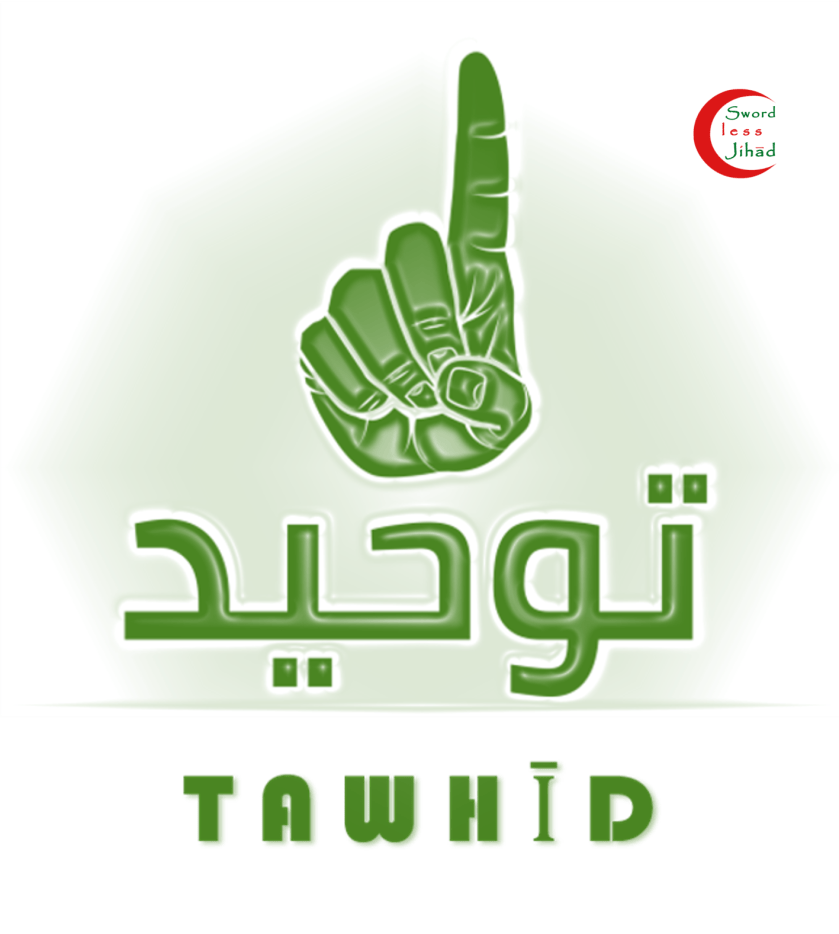
From what has been said, it appears clear that Tawhīd for us Muslims is the foundation of everything and the “misguided of Jihād” know this well! So, what have they done to profit from it, in an attempt to legitimize their atrocities and attract proselytes? A rebranding of Tawhīd: they created a symbolic gesture that recalls the concept, the famous raised index finger, and they show it as a trademark every time they carry out a terrorist attack against places and people that in some way represent – according to their conspiracy doctrines – the “morally decadent Western world”, that is, “the enemy of Islām par excellence”.
In reality, by associating a symbol that recalls something as sacred as Tawhīd to their criminal acts (desired by them and not by Allāh swt!!), they themselves become promoters of shirk because they would like to make people believe that their acts are guided by Allāh swt. In doing so, they place their (deviant) example on the same level as an edifying act for the believer, interposing themselves, de facto, between Him and them.
We, at Swordless Jihād, want to reclaim this symbol ☝️ and to restore its correct use, as an ordinary gesture to make in the normal course of our daily actions, thus reminding ourselves and others that our earthly life is guided in its entirety by the foundation of Tawhīd.
As we say this, we are very far from the position of those who claim the role of mediation between believers and Allāh swt, because this role has no right to exist. We reiterate: between Allāh swt and the believer, there is a direct line without intermediaries.

 Jihād senza Spada