
Reading time: 9 min.
In this part of the world, the Euro-Afro-Arab-Middle Eastern macro-continent, we know little about Islām and Muslims in the lands of the so-called Central Asia. At most, we receive superficial reports that do not delve deeply into the dynamics that are underway at the local level and, therefore, cannot offer enough elements to understand the actual scenario. Hence, as members of the editorial staff of the blog Swordless Jihād, we realized all our ignorance when a brother from Tajikistan named Jamshed, a 27-year-old mū’min based in the capital Dušanbe, surprisingly contacted us on Telegram, raising an alarm to which we could not fail to pay due attention.
Through the long conversations with Jamshed, both written and vocal, we learned with dismay about the events that are plaguing the Ummah in Tajikistan, as well as in other countries of the area. The fitna brought about by the usual “misguided of jihād” and by the multiple aḥzāb keeps on targeting the traditional ‘Ahl as-Sunnah wa’l Jama’ah, which is almost on the verge to disappear. A disturbing picture, to say the least. To find evidence and confirmation of what Jamshed told us, we have consulted other brothers and sisters who are much more knowledgeable than us on the Tajiki context and, Subhānu’llāh (سبحان الله), from a critical examination of the accounts heard from him, we came to the conclusion that the “Jamshed’s version” is truthful and for this reason we decided to share it with you. Now, it is time to leave him the floor. Hold on tight and enjoy the reading.
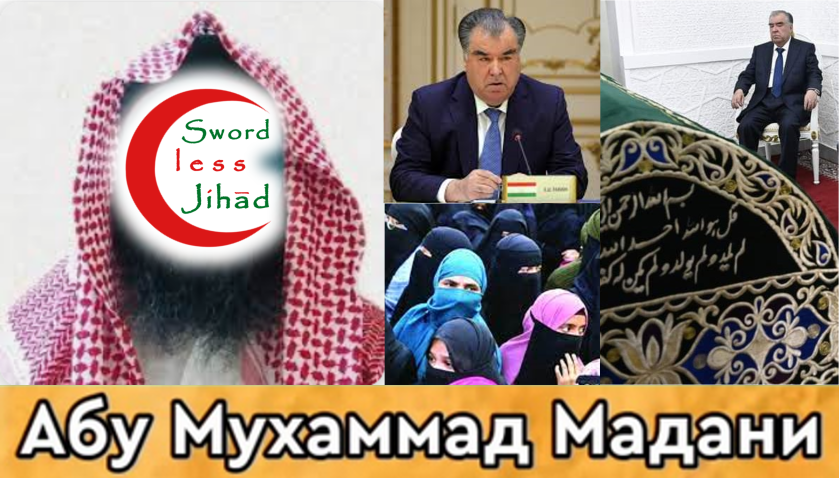
Tajikistan is continuing its unstoppable descent down the road to “perdition”. To begin with, the Ṭāghūti regime of the “tyrant” Emomali Rahmon has been persecuting the Tajiki Muslim population for almost thirty years, in his endeavor to dismantle piece by piece the country’s thousand-year-old Islamic tradition. The recent ban on women wearing the hijāb in public places, along the lines of the ban that has long been in force in schools, hospitals, and in any other context linked to the “state”, is only the latest of the anti-Islamic repressive measures introduced by Rahmon.
Among them, suffice to remember that he barred young people under 18 years old from going to the mosque for the salāt al‑Jumuʿah, he outlawed the sale of clothing that complies with the Islamic culture (spreading the lie of their alleged incompatibility with the Tajiki customs), and he even closed thousands of mosques to transform them in some cases into tea rooms and medical centers. Not to mention the police searches suffered by bearded men, as every Muslim adult male should be according to the prophetic model of Muḥammad saw.
These are serious Islamophobic acts of coercion and violence, justified by resorting to the excuse of preventing extremism and terrorism. However, first al-Qāʿida and then the kuffār of the IS in the “province” of Khurasan (ISKP) have largely benefited from Rahmon’s anti-Islamic policies to recruit new militants, capitalizing on the anger felt towards him by the population. Therefore, the government and the terrorists are enemies only on the surface, since they play into each other’s hands to the detriment of Islām and Muslims.
In this respect, Tajikistan is similar to the other post-Soviet “republics”, such as Kazakhstan, Uzbekistan, Kirghizstan, and Turkmenistan, where local “tyrants” – always under the pretext of terrorism of course – have imposed on Islām the usual process of “secularization”, although they call themselves Muslims.
Actually, they are just professional munafiqūn disguised as “Sufis” to appear “peaceful and moderate” in the eyes of both the Western and the Russian Ṭāghūt, but they possess nothing of the authentic traditional taṣawwuf. Rather, they seem like followers of the new age neo-paganism, mushrikūn completely disconnected from Allāh swt and His cause.
This is the result of decades of state atheism, which has led to the diversion of religion. On the other hand, in continuity with the old course, local “tyrants” have not lost the habit of repressing what threatens their power, starting with the very Islām that they claim to represent. And if you are not with them, you are against them and for ordinary Muslim citizens the danger is marginalization in the social and labor fields, and even in the access to basic services. Thus, to survive they are forced to adapt to the restrictions, behaving like good “subjects” of the regimes that are tyrannizing them.
To make the situation even worse here in Tajikistan is the fact that the opposition to Rahmon is composed exclusively of “deviant” Khawāriji groups and individuals, in particular the Ikhwān (i.e. the “Muslim Brotherhood”) and the radical shuyūkh ideologically close to ISKP (although they are not officially affiliates), such as Abu Muḥammad al-Madani.
Al-Madani’s influence, especially among young people, has long been a major thorn in Rahmon’s side. With his pseudo-fatāwā and fiery statements, capable of reaching hundreds of thousands of followers online, al-Madani has managed to build around himself a core of militants engaged in propaganda activities (and not Da’wa as they improperly call it), many of whom have made the fateful transition into the ranks of ISKP.
Rahmon has sought to narrow al-Madani’s range of action, with arrests, killings, and mosques burned in mysterious circumstances. At the same time, Rahmon has never directly targeted al-Madani, fearing the mobilization of his followers and a further strengthening of ISKP, which would tip the balance excessively in favor of the terrorist organization.
The turning point in the relationship between Rahmov and al-Madani came about following the ISKP attack at the Crocus City Hall in Moscow, carried out by Tajiki militants. Concerned by the rise of ISKP in the area and of the Tajiki component within it, Rahmon asked for al-Madani’s help, ensuring him money and security to distance himself from the terrorists. The offer was accepted by al-Madani, in return for greater freedom in terms of propaganda, but to be directed against ISKP and no longer against Rahmon.
As a result of the agreement, al-Madani condemned the massacre in Moscow, denying the credibility of the claim by ISKP and stressing that the perpetrator of the attack was the Russian intelligence, so as to completely dissociate Tajikistan (and himself) from the attack, as per Rahmon’s desire.
Resented by the turnaround, ISKP issued a fatwā against al-Madani, disavowing him as a friendly “sheikh” both ideologically and as a source for the recruitment of militants.
On his part, al-Madani does not seem to be concerned about the charges of disbelief (takfīr) hanging over his head and, hiding behind a screen, continues to give online lessons in some country outside Tajikistan where he has found refuge, without showing his face. However, I attended these live streaming lessons and I definitely understood that al-Madani is also betraying the true Islām, leading many young Muslims away from the “straight path”.
Nevertheless, Rahmon appealed to Madani to increase his efforts to counter the Ikhwān with his propaganda, especially among young people. At the same time, Rahmon seems willing to slightly loosen his grip on the obligation not to wear the hijāb in public, in order to facilitate the collaboration with al-Madani and neutralize the opposition of the Ikhwān.
For the life of Muslims in Tajikistan this can be at least a breath of fresh air, but these latest developments confirm a dramatic and alarming trend, namely the total irrelevance of the ‘Ahl as-Sunnah wa’l Jama’ah in the local scenario.
The Islām of the madhāhib, above all the Hanafī school (historically the most widespread in Tajikistan), is today excluded from the religious space, which has instead been occupied by the “tyrant” Rahmon and his instrumentalization of Sufism for power purposes, on the one hand, and by the Khawārij in their various forms, on the other.
The sincere muʾminīn, who hold their īmān firmly and resolutely fī sabīli ‘llāh, do not have a say at the moment, but they are many, confused among the population that follows the regime’s schemes without batting an eyelid. They are actually the majority of the Tajiki Muslims, brothers and sisters who in their hearts do not submit to any ḥizb or any “deviant” sect, while silently resisting.
Perhaps, however, facing circumstances that have become intolerable, the time has come to break the silence and rebel. Let us pray Allāh swt to preserve and support us, and may He show the Tajiki Muslims the “straight path” to undertake in order to re-establish the primacy of authentic Islām. Pray with us.
 Jihād senza Spada